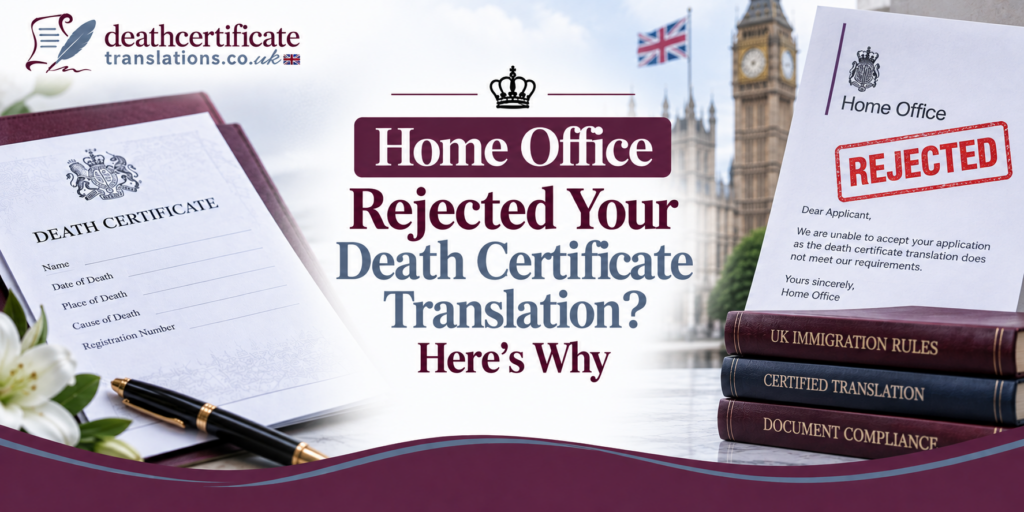
The Home Office rejects a death certificate translation mainly for formal defects, not language errors — a missing statement of accuracy, no translator signature, date or contact details, untranslated stamps and seals, self or machine translation, or name spellings that clash with your passport. Most are fixable, and a corrected translation can usually be resubmitted.
You did everything that was asked of you. The certificate was translated, the file was uploaded, and then the letter came back saying the document was not accepted. It is a horrible moment — you were already coping with a bereavement, and now the paperwork feels like it has turned against you.
Here is what we can tell you from repairing these cases every week: the problem is almost never that the translator misunderstood the language. It is one specific formal requirement that was missed. A signature. A stamp nobody translated. A name written one way on the certificate and another way on your passport. Small things, and each one correctable once you know which one caught you.
At Death Certificate Translations, we see the same short list of errors repeat across every language and every country of issue. This guide helps you find yours, fix that one thing properly, and submit again without repeating the cycle.
Why The Home Office Rejected Your Death Certificate Translation — Start With The Letter
What Your Refusal Or Request Letter Is Really Telling You
Before ordering anything new, find the exact wording used about your document. The Home Office is pointing at one of three different problems, and each needs a completely different response.
- 📌 A translation defect — the English version fails the certification standard. Most common, and the easiest to put right.
- 📌 A document defect — the overseas record itself was insufficient, unverifiable or the wrong type. A new translation will not help here.
- 📌 An evidence gap — the certificate does not prove what the immigration rule requires. That is a case issue, not a language issue.
💡 If the letter mentions the accuracy statement, the translator or legibility, you have a translation defect. If it questions the certificate’s completeness or authenticity, you need a fresh copy from the issuing registry abroad before anything is translated again.
Why Overseas Death Records Are Scrutinised More Closely
Foreign civil registries all format records differently. Some issue a brief extract, others a full register copy, and some produce multilingual international extracts. A caseworker comparing an unfamiliar layout against an English page needs every element accounted for. Anything absent reads as something withheld, even when it was simply overlooked.
Certification Errors That Get A Death Certificate Translation Rejected By Ukvi
Most documents we are asked to repair fail on this list. Check yours against every point.
- ✔ No statement of accuracy. The English page must clearly confirm it is a true and accurate translation of the original. Without it, the document is just a typed page.
- ✔ Unsigned or undated. Both are needed. A digital file carrying a typed name but no signature is regularly refused.
- ✔ No named, contactable translator. A full name and contact details must appear so the work can be verified independently. Agency branding alone does not satisfy this.
- ✔ Self-translation. You cannot translate or certify your own document, and neither can your spouse, sibling or friend — however fluent or qualified they are. Independence is the whole point.
- ✔ Machine translation. Output from free online tools is recognisable immediately and carries no accountable certification behind it.
- ✔ Certification written in the wrong language. For a UK submission, the accuracy statement itself must be in English.
➔ In our experience, a document failing on only one of these points is fully recoverable. You usually need a compliant version of the same translation, not a whole new application.
Content And Formatting Errors In Overseas Death Record Translations
Partial Translation And The Elements Most Often Missed
Every mark on the certificate forms part of the record. The items most commonly left out are:
- Official seals and embossed stamps
- Handwritten registrar entries and marginal notes
- Register, volume, entry and folio numbers
- Reverse-side text and continuation pages
- The issuing office name and the date the copy was issued
If it appears on the original, it belongs in the English version — described where it cannot be translated, never quietly dropped.
Name, Date And Place Mismatches That Look Like Inconsistent Evidence
This is the error that does the most damage, because it presents as a contradiction in your case rather than a translation fault.
- 📌 Transliteration. Arabic, Urdu, Cyrillic and Devanagari names can each be rendered several defensible ways. If your file says “Mohammed” and the translation says “Muhammad”, a caseworker sees two different people.
- 📌 Date formats. A certificate showing 03/04/2019 means one date in Warsaw and another in Manila. Ambiguous dates should be written out in full.
- 📌 Place names. Cities, districts and provinces are renamed and respelled over time. The version on the record must be reflected, with the modern equivalent noted where it helps.
- 📌 Legibility. Dark, cropped or angled scans force guesswork. Photograph the document flat, in daylight, with all four corners visible.
Certified Vs Notarised: What UKVI Actually Needs After A Rejected Death Certificate Translation
Many people react to a rejection by ordering the most expensive option available. That is usually unnecessary, and it costs you time you may not have.
| Question | Certified translation | Notarised translation |
|---|---|---|
| What is confirmed | Accuracy of the translation, signed by the translator | The translator’s identity, witnessed by a notary public |
| Typical UKVI position | Sufficient for most immigration submissions | Rarely requested by UKVI itself |
| Turnaround | Fastest — best when resubmitting under pressure | Slower, adds an appointment step |
| Genuinely needed for | Visa, settlement and citizenship files | Embassies, foreign authorities, some overseas and court uses |
| Does it repair a rejection? | Yes, when the defect was certification | No, if the defect was a missing stamp or the wrong document version |
➔ Notarisation does not fix a flawed translation. If your letter criticised content or completeness, upgrading the certification level changes nothing at all.
How To Correct And Resubmit After The Home Office Rejected Your Death Certificate Translation
- Isolate the single stated reason. Quote the exact sentence from your letter when you contact us. It determines everything that follows, and guessing is what causes a second rejection.
- Confirm you hold the right version of the overseas record. If your country issues both a short extract and a full civil registry copy, and the extract lacks required detail, request the full copy from the registry before translating anything.
- Audit your existing translation against the certification list above. Frequently the answer is a properly executed version rather than a fresh order from scratch.
- Standardise names across your entire file. Tell us the spelling used on your passport and application. Where the original differs, we translate faithfully and note the variant, so the difference is explained rather than discovered.
- Supply a clean, complete scan. Every page, both sides, flat and legible. Poor images cause more repeat rejections than genuine translation difficulty ever does.
- Have it checked before it goes back. A second specialist verifies names, dates and register numbers against the original. We would far rather find a problem than let a caseworker find it.
- Ask an adviser about the route, not us. If the refusal questions whether the certificate proves your case at all, that is a legal matter for a qualified immigration adviser — confirm your position with them before resubmitting.
Frequently Asked Questions About Home Office Rejected Death Certificate Translations
Can I Resubmit A Corrected Death Certificate Translation To The Home Office?
Yes, a corrected translation can normally be submitted, either in response to a request for further information or with a fresh application. Follow the instructions in your own letter, as deadlines and routes vary by case.
Why Did The Home Office Reject My Death Certificate Translation When The Wording Was Accurate?
Because accuracy is only one requirement. Rejections usually follow a missing accuracy statement, signature, date or translator contact details, or untranslated stamps and seals — not mistranslated language.
Who Is Allowed To Certify A Death Certificate Translation In The UK?
An independent professional translator or translation provider can certify it, supplying their name, signature, date and contact details. You cannot certify a translation of your own document, and neither can a relative.
Will A Rejected Translation Harm My Future UK Applications?
A rejection for a certification or formatting defect is an evidential issue, not an allegation against you. If your letter raises concerns about a document’s genuineness, speak to a qualified immigration adviser before you proceed.
Do I Need To Send The Original Overseas Death Certificate To Be Translated?
Usually not — a clear, complete scan or photograph is enough for us to work from, even when family send it from abroad. Keep the original safe, as the authority handling your case may still ask to see it.
Talk To Us Before You Resubmit Your Overseas Death Record Translation
A second rejection costs far more than the first — more weeks, more worry, and sometimes a deadline you cannot get back. You should not have to guess your way through it while you are grieving.
So let us take the guesswork out of it. Send us three things: your existing translation, the certificate itself, and the sentence from the Home Office letter that refers to the document. Our specialists will tell you plainly which of the errors above applies to your case, whether the overseas record you hold is the right version, and exactly what has to change. If your current translation only needs compliant certification rather than full re-translation, we will say so. If the real problem is legal rather than linguistic, we will tell you that too, instead of selling you a document that cannot fix it.
What you get back is straightforward: an independent named translator, complete coverage of every stamp, seal and entry, name spellings consistent with the rest of your file, and a document checked twice before it reaches you — ready to submit the moment it lands.
➔ Send us your rejected translation for a free error check and we will come back with a clear diagnosis and a firm timeline before you commit to anything.