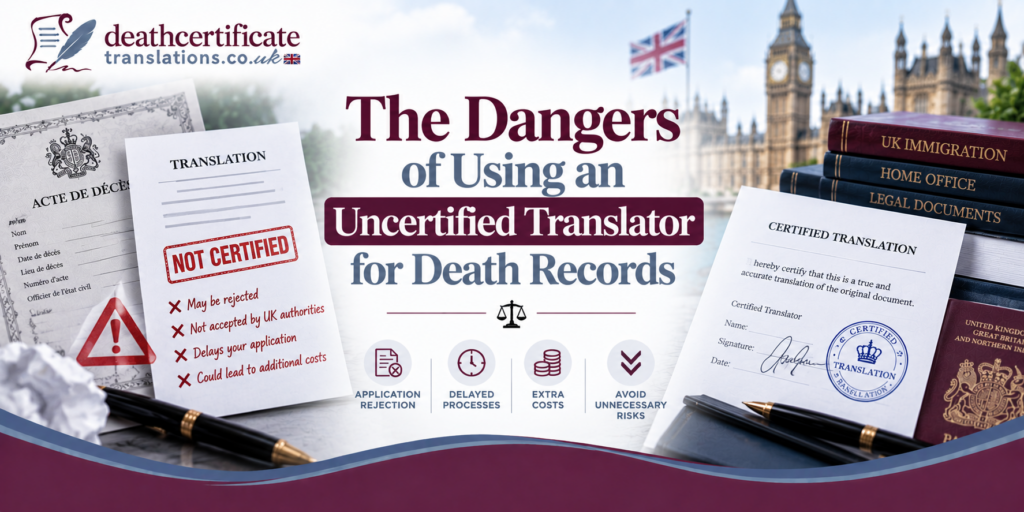
A death certificate translation that isn’t certified doesn’t get politely corrected — it gets sent straight back.
That’s the part most families don’t find out until it’s already happened. You’re managing probate, or a solicitor has asked for the certificate translated before a filing goes in, and someone in the family offers to do it — a cousin who grew up bilingual, or a same-day online tool that promises the wording will be “close enough.” It feels like the sensible shortcut. It isn’t, and the risks of non-certified translation for legal death certificates rarely show up as a small inconvenience. They show up as a probate case stalled in the queue, a court filing a solicitor can’t submit, or a bank release put on hold because the paperwork that landed on someone’s desk doesn’t meet the standard they’re required to work to.
At Death Certificate Translations, this is a pattern we recognise instantly. A relative translates the certificate carefully, gets almost every word right, and it still comes back — not because the translation was wrong, but because nobody signed off on it in a way HMCTS, a solicitor, or a probate registry can actually rely on. This guide sets out exactly where that gap shows up, what it costs once it does, and what a translation needs to include before it ever lands on someone’s desk.
A non-certified death certificate translation — done by a bilingual relative, a machine translation tool, or an unverified freelancer — is missing the signed certification statement that HMCTS, solicitors, and UK probate registries require. Without it, the translation is almost always rejected outright rather than corrected, which means the whole document has to be redone by a certified translator before the case can move forward again.
Why Families And Executors Reach For A Non-Certified Translation First
This isn’t carelessness — it’s what happens when you’re already stretched thin. When you’re mid-probate, chasing a bank form and a court list date in the same week, a bilingual cousin or a fast online tool looks like the obvious shortcut rather than a risk. Plenty of executors assume any accurate translation will do, as long as the meaning comes across correctly, and only discover that “translation” and “certified translation” are two separate things once a solicitor’s rejection email lands in the inbox. We see the same story play out on repeat: someone translates the certificate themselves, attaches it to the estate file with real confidence, and finds out weeks later — once the case has already moved on without it — that it was never going to be accepted as it stood.
What Counts As A Non-Certified Death Certificate Translation In A Uk Legal Setting
Not every translation that reads perfectly well in English will hold up once a solicitor or court clerk looks at it properly. Three situations account for almost everything our specialists see go wrong.
A Bilingual Friend Or Family Member Translation
A relative who’s genuinely fluent in both languages can usually get the meaning right without much trouble. What they can’t do is stand behind it independently. HMCTS, solicitors and most institutions expect the translator to have no personal stake in the outcome — a direct family member almost never clears that bar, however good their language skills are, because courts are cautious about anyone connected to the case vouching for their own work.
Google Translate Or Ai Translation Tools
Machine translation can misread names, dates, register numbers and place names on an official document — and it produces nothing that confirms the result is accurate. That missing confirmation, not the wording itself, is usually the actual reason a court-admissible translation gets turned away. A register number transposed by a single digit, or a place name rendered phonetically instead of officially, is exactly the kind of error a machine tool won’t catch but a solicitor will spot immediately.
An Unverified Freelancer Or Overseas Agency
Price-comparison sites are full of fast, cheap translation offers, and some of them are perfectly capable linguists. The catch is that many overseas or unverified providers don’t issue anything UK courts and solicitors recognise as valid, and they’re often impossible to reach if an official needs to check the document later. Ask any provider directly how a document this sensitive is stored and who actually sees it — not just how quickly it can be turned around.
Certified Vs Non-Certified: What Courts And Solicitors Actually Check
Laid out side by side, the gap between the three routes has less to do with language skill and more to do with what’s missing on paper.
| What Gets Checked | Certified Translator | Bilingual Friend | Machine Translation |
|---|---|---|---|
| Signed certification statement | Included as standard | Not legally valid | Not provided |
| Named, contactable translator | Yes, on the document | Rarely independent | No named translator |
| Accepted by HMCTS/solicitors | Standard requirement met | Usually rejected | Almost always rejected |
| Handles legal terminology accurately | Trained in legal wording | Depends on familiarity | Frequently misreads terms |
| Confidentiality of a sensitive document | Handled under professional standards | Shared informally | Processed by third-party servers |
⚠️ COMMON PITFALL: Older or handwritten death certificates are where DIY translations go wrong most often — a faded register entry or an unfamiliar civil registry format is easy for a non-specialist to misread, and that kind of error can sit unnoticed until an official checks it against the original.
What Happens When Hmcts Or A Solicitor Rejects Your Translation
The real cost isn’t embarrassment — it’s time, and in a probate or court case, time is usually the one thing nobody has to spare.
Submission sent ➔ Clerk or solicitor reviews the certification ➔ No signed statement or verifiable translator is found ➔ Document is returned or the file gets flagged ➔ Case is paused until a compliant translation arrives ➔ New translation is commissioned and completed ➔ File is resubmitted and waits for review again
Every step in that chain can add days, sometimes weeks, especially inside a court list or a probate queue with dates that don’t move to suit you. In our decade of handling official documents, the files that move fastest are, without exception, the ones where a properly certified translation went in on the first attempt.
What A Legally Sound Death Certificate Translation Must Include
1. A signed statement from the translator confirming the English version is a true and complete record of the original
2. The translator’s name and contact details, so an official can get in touch to verify it
3. Layout that mirrors the original certificate, so the two can be checked side by side without confusion
4. Every name, date and register number carried across in full, with nothing summarised or quietly left out
5. Formatting suited to the specific authority receiving it — HMCTS, a solicitor’s file and a probate application can each expect slightly different presentation
💡 PRO TIP: Not sure whether your case genuinely needs a translation this thorough? Ask the court, solicitor or registry directly before you commission anything — a two-minute question that can save weeks of back-and-forth later.
Frequently Asked Questions
Can A Bilingual Family Member Translate A Death Certificate For A Solicitor Or Court?
Not for a legal submission, no. Even a completely accurate translation from a relative is generally turned down because the translator isn’t independent, and family members can’t provide the certification a solicitor’s file or an HMCTS filing needs to rely on.
Will Google Translate Or An Ai Tool Work For A Legal Death Certificate Translation?
It isn’t a safe option for court or solicitor use. Beyond the risk of mistranslated names and register numbers, machine tools simply don’t produce the signed confirmation legal and probate paperwork is built to expect.
What Happens If A Court Or Solicitor Rejects An Uncertified Translation?
The document is usually sent back rather than fixed on the spot, so the case is paused until a properly certified version arrives — in practice, that means starting again with a qualified translator rather than amending what you already have.
Does A Death Certificate Translation Legally Have To Be Certified In The UK?
For probate, HMCTS filings and most solicitor case files, yes — a signed certification statement is the standard expectation. What counts as sufficient can still shift slightly by case, so it’s worth confirming with the court or solicitor directly before you go ahead.
Can We Use An Overseas Translator Or Notary Who Isn’T Based In The UK?
It’s possible, though it adds a real element of risk. A translator working outside the UK typically has no established relationship with the court or solicitor receiving the document, so there’s nothing to fall back on if the paperwork needs checking — and coordinating an urgent fix across time zones rarely helps a deadline that’s already tight.
Getting It Right Without Losing Time
None of this is about making an already hard process harder than it needs to be. It’s about not going through it twice. Most families who end up with a rejected translation didn’t do anything reckless — they made a reasonable-sounding decision under pressure, and it cost them exactly the time they were trying to save. A properly certified translation, done once, by a translator who’s named on the document and reachable if a court or solicitor ever needs to check it, is genuinely the difference between a probate case, a court filing or an estate matter moving on schedule, and one that sits waiting in a queue for a second attempt.
If you’re holding a foreign-issued death certificate that needs to stand up to that kind of scrutiny — for a solicitor’s deadline, a court date, or a probate application already in motion — it’s worth getting it right from the first submission. Send Your Death Certificate for a Certified Quote and our certified translators will tell you plainly what your specific case needs, before you spend a penny or a single extra week on it.